|
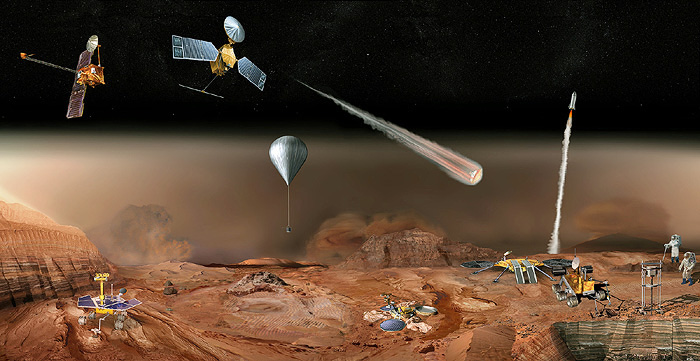
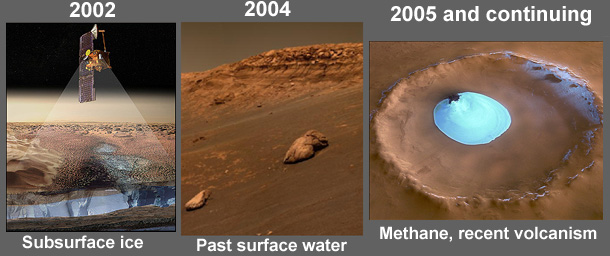
The Mars program is designed to follow
up on new discoveries, or put another way, it is "discovery-driven".
That means it is impossible to say right now exactly what type
of mission should be flown for 2011 and beyond. Mars scientists
are going to see what the current missions discover before recommending
what should come next. A good example is the extensive amount
of ice that Mars Odyssey discovered on Mars. The decision was
made to follow up that with a 2007 lander named Phoenix that
is capable of digging into the ice near the North Pole and directly
analysing it. Mars missions take years to prepare so a decision
has to be made about 4 years or so before the launch opportunity.
That means that JPL is kept busy preparing many different options,
all of which require years of technology development and mission
planning.
In January, 2007
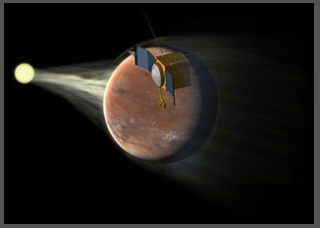
NASA HQ selected two candidate Mars Scout proposals: "MAVEN" and "The Great Escape".
See also "NASA
Selects Proposals For Future Mars Missions And Studies"
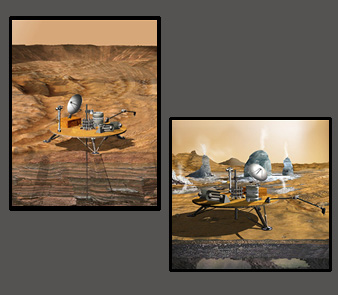
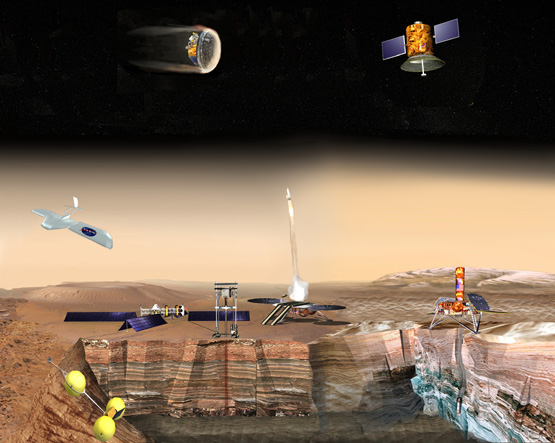 Sample return and subsurface
access are part of the future Mars program
Sample return and subsurface
access are part of the future Mars program
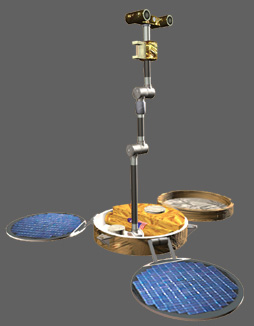
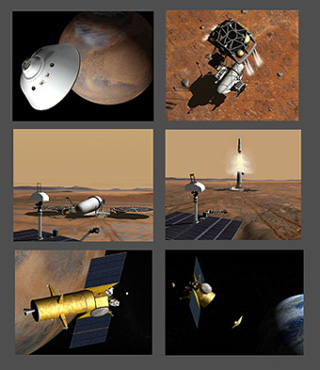
Future missions may include a 2016
Mars Science Orbiter (MSO). In 2020 a Mars Sample Return lander
and rover may be sent.
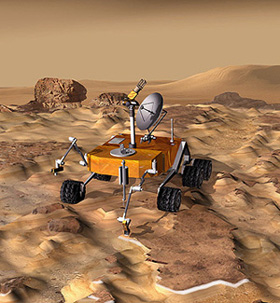
Earlier possibilities for the next
decade used to include an Astrobiology Field Laboratory rover
followed by a Deep Drill Lander. But these proposed missions
seem to have fallen by the wayside. A new
landing technique is being developed
for some of the next decades missions which would use a skycrane.
The Mars program has always been
evolving and always will .......that's just the nature of the
exploration business. Expect the unexpected and be prepared to
take advantage of it! |























%20above%20the%20planet's%20surface,%20then%20releases%20the%20Mars%20Science%20Laboratory%20with%20a%20tether.%20Credit:%20NASA/JPL)